


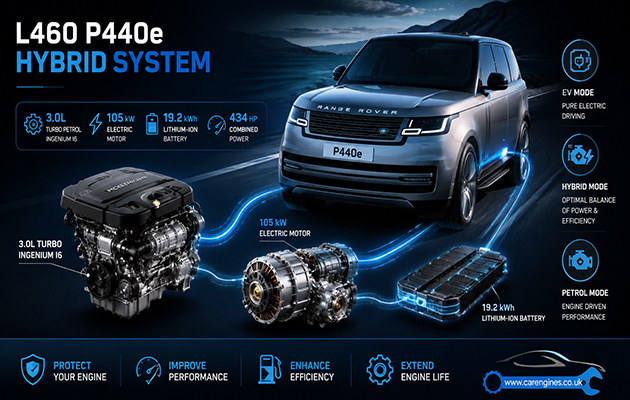
The L460 P440e’s hybrid powertrain combines a 3.0-litre turbocharged Ingenium inline-six petrol engine, a 19.2 kWh lithium-ion battery, and a 105 kW electric motor delivering 434 horsepower in total. Land Rover quotes 62 miles of pure-electric driving under WLTP testing, although real-world figures in UK conditions typically reach 25 to 35 miles depending on temperature, load, and driving style.
The control system switches between EV mode, blended hybrid, and petrol-only operation by continuously monitoring battery charge level, throttle position, ambient conditions, gradient, and auxiliary electrical demand. The combustion engine operates as an integrated propulsion unit, not a backup. When these engines fail, drivers searching for **car engines** through an **engine finder UK** network discover a wide range of **replacement Range Rover engines** available from verified UK stock.
Land Rover engineers set the P440e to engage the petrol engine once the high-voltage battery reaches roughly 10 to 15 percent state of charge. This threshold adapts continuously — steep terrain, winter temperatures, and heavy electrical loads push the trigger point higher. The system logic makes practical sense: maintaining predictable drivability takes priority over maximising electric range in challenging conditions.
An important detail many owners don’t know: the petrol engine can start briefly even when EV mode is deliberately selected. It activates to warm the catalytic converter to meet Euro 6 emission standards, supply cabin heat via the engine’s coolant circuit when the electric PTC heater reaches its limit, or handle sudden electrical demands from the rear defroster and heated seats operating simultaneously. This behaviour is confirmed in Jaguar Land Rover’s Technical Service Bulletin TSB-23-PHEV-04 (2023): “The internal combustion engine (ICE) may activate autonomously to maintain system integrity, even when EV mode is selected.”
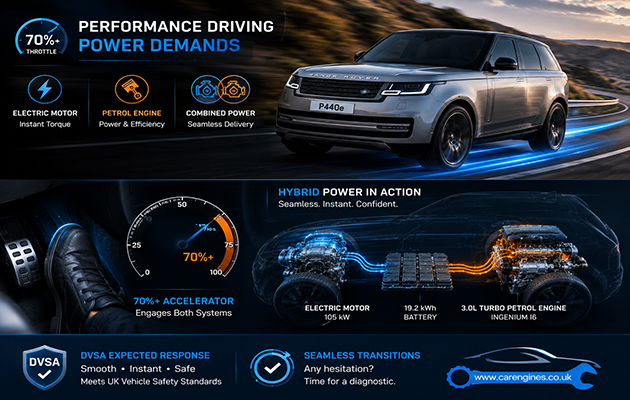
Accelerator travel beyond approximately 70 percent — during a motorway slip-road merge or an overtaking manoeuvre on a single carriageway — engages both the electric motor and the petrol engine simultaneously. The combined torque delivery is seamless, and this response is precisely what the DVSA expects from hybrid drivetrains under UK vehicle safety standards. If these transitions feel anything other than smooth and instant, the car needs a diagnostic.
The DVSA’s revised inspection manual introduced hybrid-specific checks from May 2024. A deteriorated high-voltage battery by itself won’t fail the MOT. Three related conditions, however, will:
An illuminated hybrid system warning or check engine light is an automatic failure regardless of how well the vehicle drives. Excessive emissions during forced combustion-engine operation — triggered when the hybrid management system isn’t functioning correctly — will fail the emissions test. Any stalling during mode transitions while the tester is operating the vehicle is recorded as a dangerous defect.
The GOV.UK inspection guidance for hybrid vehicles requires “normal operational behaviour,” which specifically means smooth, predictable switching between power sources. A “Hybrid System Fault” dashboard message demands investigation before your MOT appointment. Battery module degradation or inverter faults can indirectly trigger the emissions or drivability problems that test equipment will record as failures.
Normal seasonal range variation is expected. Actual battery failure shows different symptoms: EV range consistently collapsing from 30-plus miles to single digits even after a complete overnight charge, the petrol engine engaging within moments of pulling away from a full charge, noticeable hesitation during electric-only acceleration, and distinct mechanical sounds from the rear battery compartment area.
The Battery Management System logs cell balance, thermal history, and charge retention continuously, but requires JLR SDD or Pathfinder dealer-level diagnostic tools to access. Full battery replacement costs between £8,000 and £12,000 fitted — a sum that leads some owners to investigate conventional engine conversions, though such modifications void type approval and demand re-certification through a DVLA-registered modifier.
The L460 P440e will operate on petrol power alone with a fully discharged or disconnected high-voltage pack, but the compromises are significant. Fuel consumption deteriorates to 15 to 18 mpg. The gearbox may restrict itself to limp mode to protect the clutch packs from abnormal loads. Regenerative braking is lost entirely, accelerating brake component wear to approximately triple the normal rate. And, crucially, any dashboard warning lights remaining illuminated will cause an automatic MOT failure.
The SMMT advises against extended driving in this condition due to the excessive strain placed on the starter-generator and the 48V mild-hybrid electrical architecture. The risk of a cascading multi-system failure makes continued operation economically indefensible.
The Ingenium AJ30 petrol engine in the L460 can be replaced independently of the hybrid electric system. When timing chain failures or oil starvation events occur, the electric drive components often remain intact and functional. A replacement engine is substantially cheaper than the financial loss of scrapping a vehicle of this value.
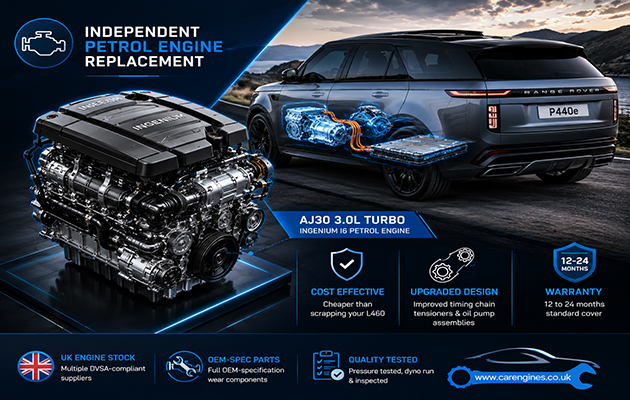
Across our **UK engine stock**, **replacement car engines** for the L460 P440e are available from multiple DVSA-compliant suppliers. Reconditioned units typically incorporate updated timing chain tensioner designs and improved oil pump assemblies alongside full OEM-specification wear component replacement. Standard warranty provision ranges from 12 to 24 months.
Professional reconditioning follows a structured process: complete disassembly with hybrid system high-voltage isolation checks, block and cylinder head pressure testing with machining to factory specification, replacement of every wear component with OEM-spec parts, followed by compression testing, leak-down analysis, full hybrid system diagnostics, and calibration to Land Rover’s factory parameters. When sourcing **car engines** through a professional network, check that the supplier can document each of these stages.
For the overwhelming majority of L460 P440e owners, petrol engine activation during low battery or high-demand driving represents normal, expected hybrid system behaviour. It’s how the vehicle was engineered to function. The key variable is the character of those transitions. Rough engagement, unexpected activation after a full charge in mild conditions, or increasingly frequent mode switching suggests battery cell degradation, DC-DC converter malfunction, or a software calibration issue requiring resolution.
Monitor your dashboard warnings and arrange a professional diagnostic if behaviour alters. Early detection of problems costs a fraction of the emergency repairs that result from ignoring the warning signs. The informed owner who acts on the first indication of trouble is the one who avoids the repair bills that genuinely hurt.Search thousands of car engines for any make and model at Car Engines — fast, free quotes.



