


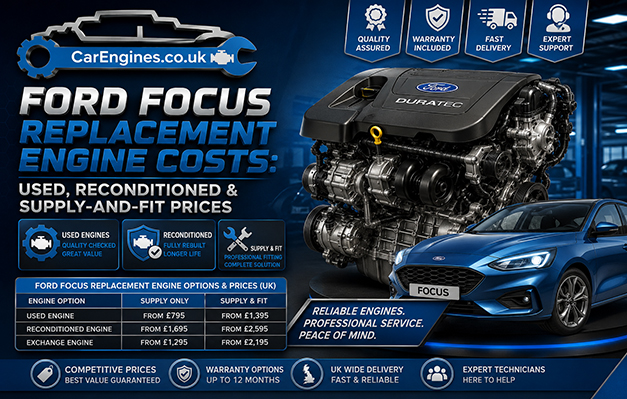
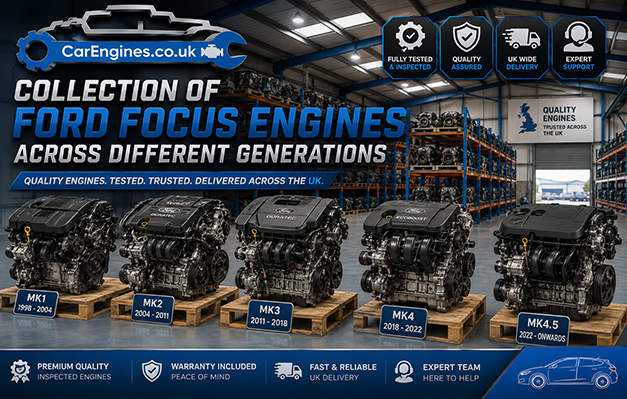
The replacement Ford Focus engine is one of the most searched vehicles on Car Engines, and understanding the differences between the 1.0 EcoBoost, 1.5 EcoBlue, and 2.0 TDCi is the first step toward making the right engine choice — whether you are buying a complete car or sourcing a replacement engine. Each of these three engines has its own character, its own strengths, and its own set of known issues that every UK buyer should understand before committing.
With thousands of Ford Focus engines passing through the UK used market every year, the information gap between what a seller tells you and what you actually need to know can be expensive. This guide covers every second-hand Focus engine variant available in the UK, the specific failure points that affect each one, and what a fair replacement cost looks like when things go wrong.
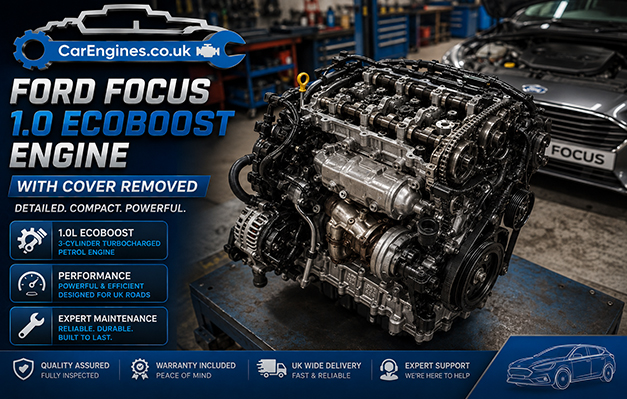
The 1.0-litre EcoBoost petrol engine earned a reputation for punching above its weight — three cylinders producing power that feels more like a 1.6-litre, coupled with fuel economy figures that rival some diesels. Direct injection, a compact turbocharger, and variable valve timing all contribute to its efficiency, but the engineering decision that most affects used buyers is the wet timing belt.
Instead of a traditional external belt or chain, the EcoBoost uses a belt that runs inside the oil sump, submerged in hot engine oil. The theory: reduced friction and noise. The reality, according to DVSA records: early belt compounds degraded chemically when exposed to incorrect oil formulations, shedding particles that block the oil pump and destroy the engine. Ford revised the belt specification and introduced extended warranty coverage for affected vehicles, but any used EcoBoost without documented belt replacement history carries a genuine risk.
The EcoBoost wet belt demands the exact Ford WSS-M2C948-B oil specification. Generic 5W-30 oils — even high-quality synthetics — contain additive packages that chemically attack the belt material, accelerating degradation. A service history showing regular oil changes at independent garages means nothing unless the correct specification was used. When buying a used car or engine, look for main dealer or Ford-specialist service stamps rather than generic garage receipts.
The EcoBoost cooling system relies on plastic components — the degas hose, water pump housing, thermostat housing — that become brittle over time. A slow coolant leak is easy to miss. The engine runs slightly warmer, then a little warmer, and then the cylinder head warps and the head gasket fails. The repair approaches £1,500, and many owners at that point choose to replace the engine rather than rebuild it. Checking for crusty white or pink residue around the coolant expansion tank is a five-second visual check that can save thousands.
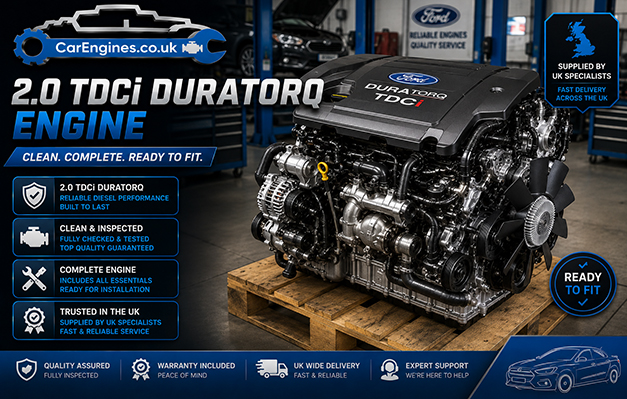
If the EcoBoost is clever engineering with a known weakness, the 2.0-litre TDCi Duratorq diesel is old-fashioned engineering with proven durability. A cast-iron block — heavier than the aluminium engines now common, but far more resistant to warping and cracking — houses a timing chain rather than a belt, eliminating the single biggest maintenance variable on the EcoBoost. This engine was co-developed with PSA Group (Peugeot and Citroen) and appears in millions of vehicles across multiple manufacturers, which means parts availability is excellent and independent garages know them inside out.
High-mileage examples at 150,000-200,000 miles are common and not a cause for concern provided the service history supports the mileage. The engine block itself is rarely the source of problems. What fails — and fails predictably — are the bolt-on emissions and fuel system components.
First: the Diesel Particulate Filter, which traps soot and requires regular motorway runs to regenerate. Town-only driving saturates the filter; replacement costs £500-£800. Second: the EGR valve, which recirculates exhaust gas and cokes up with carbon over time. Cleaning costs £150-£300; replacement runs to £400-£600. Third: the injector copper seals, which leak combustion gases and create hard carbon deposits around the injectors — the so-called black death. Replacing seals and cleaning the injector seats costs £200-£400 if caught early, but letting it progress can mean cylinder head removal. Fourth: the dual mass flywheel, which absorbs engine vibration and wears out around 100,000 miles. A replacement clutch and DMF kit fitted costs £600-£900.
The 1.5-litre EcoBlue diesel arrived in 2018 with the Mk4 Focus, bringing the latest emissions technology to meet Euro 6 standards. An integrated exhaust manifold speeds warm-up. A variable-geometry turbocharger provides strong torque from low RPM. And Selective Catalytic Reduction — the AdBlue system — reduces NOx emissions to near-zero levels. Truth be told, the driving experience is refined and the fuel economy is genuinely impressive. The maintenance experience, however, is more demanding than the engines it replaced.
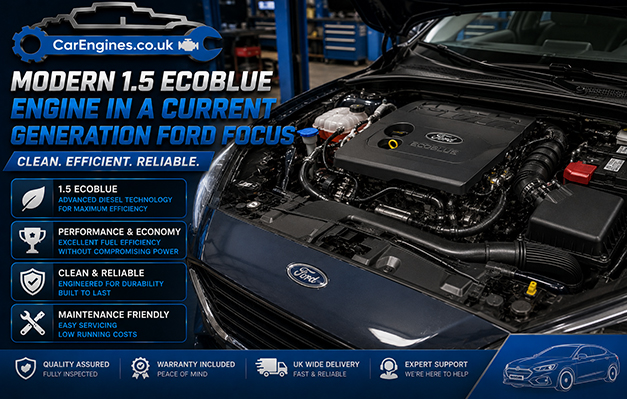
AdBlue is a urea-based fluid injected into the exhaust to break down nitrogen oxides. When exposed to air, it evaporates and leaves behind a white crystalline residue. This residue builds up inside the injector nozzle and, over time, blocks the flow completely. A blocked AdBlue injector replacement costs £350-£600. If the pump also fails due to contamination, add another £500-£800. The dashboard countdown warning that appears when the AdBlue system fails isn’t a suggestion — when it reaches zero, the ECU prevents the engine from restarting, and you’ll need recovery to a garage.
Early EcoBlue engines also had a well-documented issue with camshaft wear caused by inadequate oil supply to the top end during the first moments after a cold start. Ford’s ECU update increased oil pump output at low RPM to address this, and any 2018-2019 car or engine should be checked for evidence that the update was applied.
Car Engines lists thousands of reconditioned Ford Focus engines from verified UK suppliers, spanning every variant and generation. Current pricing for a tested, warrantied used unit ranges from £700 for an older 1.6 Ti-VCT petrol to £2,200 for a low-mileage 1.5 EcoBlue. Fitting labour at independent UK garages averages 12-18 hours at £75-£120 per hour, unless you opt. for a supply-and-fit service where the engine and installation are covered by a single invoice and warranty. A reconditioned engine — stripped, cleaned, and rebuilt with new bearings, rings, gaskets, and timing components — costs £1,800-£2,500 for the unit and is the right choice for a car you intend to keep.
High-mileage motorway drivers: choose the 2.0 TDCi. The engine itself is nearly indestructible, and the predictable maintenance items — DPF, EGR, DMF — are budgetable. Urban and low-mileage drivers: a post-2019 1.0 EcoBoost with a verified belt replacement offers the right balance of purchase price and running costs, but avoid earlier examples without belt proof. The 1.5 EcoBlue suits drivers who want a modern, refined diesel and can commit to the maintenance that the AdBlue system requires — it’sn’t an engine for someone who wants to fill up and forget.
Above all, always verify the engine code. Ford used multiple variants of each engine across different Focus model years, and the wrong code simply won’t work in your car. Enter your registration on Car Engines to find the exact engine your vehicle needs.
Shopping for any rebuilt Ford Focus engine on Car Engines means scrolling through dozens of options that look similar but carry very different risks depending on their history. We list all of them because we believe informed buyers make better decisions — and a better decision today means fewer problems tomorrow. Take your time, check the details, and if you are ever unsure which engine code your car needs, our registration lookup tool identifies the correct match instantly.
The 1.0 EcoBoost petrol engine was designed to replace larger naturally aspirated engines while meeting tightening European emissions targets. It succeeded at both goals, winning International Engine of the Year awards three years running. The design that made those awards possible — lightweight construction, a compact turbo, and the wet timing belt — is also the design that creates the highest repair bills when maintenance is skipped. Understanding this engine means understanding that its brilliance and its fragility come from exactly the same engineering decisions.
When comparing Focus engines, the most useful metric is cost per mile over your expected ownership period. A cheap engine that needs £1,500 of work within six months is more expensive than a pricier engine that runs trouble-free for three years. We have found that many buyers fixate on the purchase price of the engine — or the car — and overlook the maintenance costs that arrive within the first year. This guide exists to help you avoid that exact mistake.
The engine code is printed on your V5C registration document and stamped on the engine block itself. Enter your registration on Car Engines to automatically match your vehicle to the correct engine variant.
The 2.0 TDCi Duratorq diesel, due to its cast-iron block and timing chain design. It’s mechanically robust and, with proper maintenance, the most likely to exceed 200,000 miles without major internal work.
Not necessarily. Post-2019 EcoBoosts with the revised wet belt compound and verifiable service history using the correct oil are capable engines. The key is verifying the belt has been replaced according to Ford’s schedule.
The 1.5 EcoBlue uses a timing chain, not a belt. The chain is generally maintenance-free when the correct oil specification is used and changed regularly.
Yes. DPF removal is an automatic MOT major failure under UK law, and DVSA inspectors are trained to detect both physical and software evidence of removal.
An independent garage typically books 12-18 hours for a complete Ford Focus engine swap, depending on the variant and whether ancillaries need transferring. This translates to £900-£2,160 in labour at current UK rates.
The engine market for the Ford Focus is well-established, which means parts availability and competitive pricing that less common vehicles simply can’t offer. A 2.0 TDCi engine that costs £1,200 from a UK supplier can be fitted by any competent independent garage, and the total project cost — engine plus labour — rarely exceeds £3,000. For a car that will then deliver another 80,000-120,000 miles of service, that represents significantly better value than replacing the entire vehicle. When you use Car Engines to find your replacement, you see live pricing from multiple verified suppliers, allowing you to make a genuine value comparison rather than accepting the first quote you receive and hoping for the best.
All engines listed on Car Engines carry a minimum warranty from the seller — typically 3 months for used engine and 6-12 months for reconditioned. Check individual listing terms, as warranty coverage for labour varies between suppliers. Car Engines lists every Ford Focus engine variant available in the UK — from the 1.0 EcoBoost to the 2.0 TDCi and everything in between. Enter your registration to find the exact engine your vehicle needs, compare engine prices from verified UK suppliers, and buy with confidence.



